

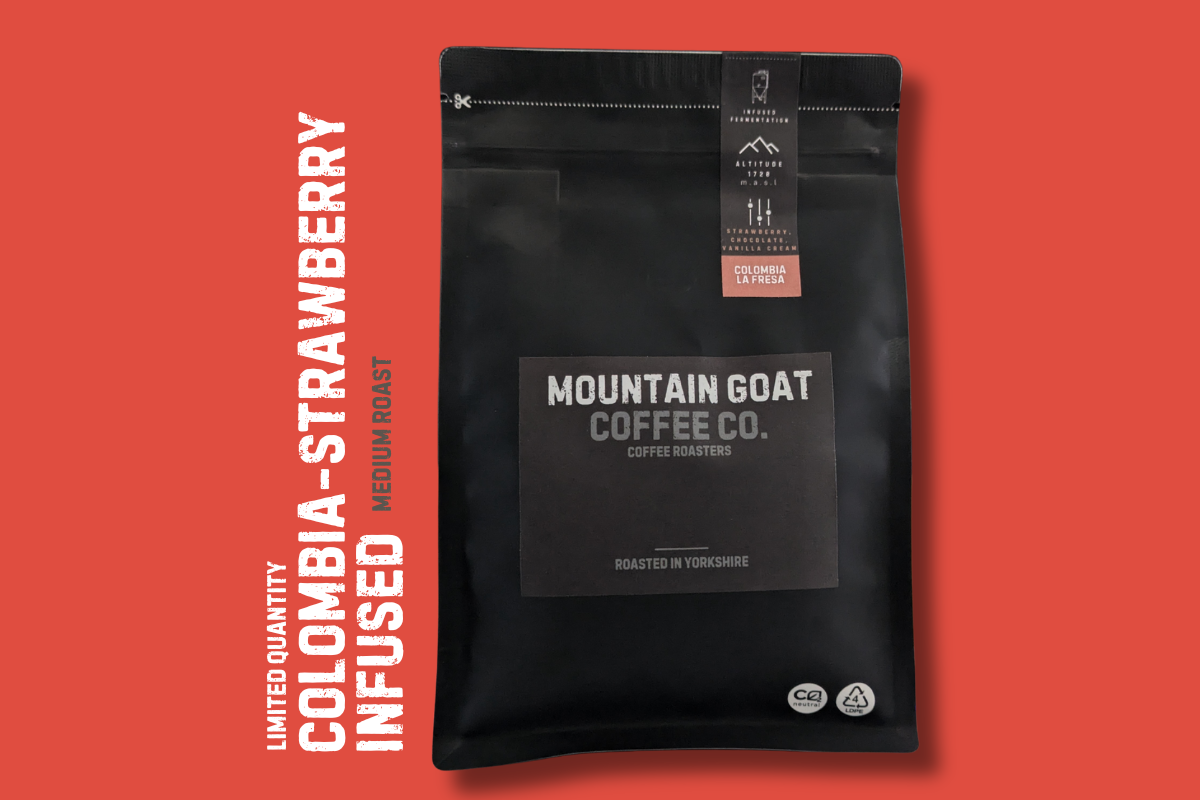
Colombia Finca La Luisa Strawberry-Infused Fermentation Honey
Colombia Finca La Luisa Strawberry-Infused Fermentation Honey
Couldn't load pickup availability
This is something truly special and unique with limited quantities so if you're looking for something extra special this is it.
Flavour Profile:
Strawberries, Chocolate, Vanilla Cream
Roast Profile: Medium
Origin: Colombia
Varietal: Caturra
Process: Double Ferment (pre and post pulping) with fresh strawberry juice
The Process
This lot utilised a double carbonic maceration fermentation in stainless steel tanks - one cherry fermentation and a second after pulping with fresh strawberries.
Ripe coffee cherries are introduced to the tank and CO2 is flushed to create an environment without presence of oxygen (anoxic). The cherries are fermented in this environment for 5 days (120 hours.)
The cherries are then removed and de-pulped but the leached liquor from the fermentation is preserved. The pulped coffee is then fermented a second time with a leached liquor from the first fermentation as well as fresh strawberries. This second fermentation takes 3 days. Finally the coffee is dried on raised beds as a honey process until the optimum moisture content has been reached.
History of Coffee in Colombia
As with many coffee origins, it is believed that coffee was first brought to Colombia by priests, arriving, perhaps, within a decade or two after coffee first came to the Americas via the Caribbean in the first half of the 17th century. It was likely a garden crop grown for local consumption and barter for decades. Unlike other coffee regions, we have the story of a priest named Francisco Romero, who could be called the father of commercial coffee cultivation in Colombia. The folkloric tale goes that in the early 1800's, Father Francisco, hearing confessions in the north eastern town of Salazar de la Palmas, assigned planting coffee to his parishioners as penance for their sins. The Archbishop of Colombia heard about this and ordered all priests to adopt the practice. Commercial production of coffee expanded quickly, moving into regions where the growing conditions were ideal.
Share
Beans have a really nice smell. I made a cold brew using these beans and you can definitely feel the strawberry scent. Good coffee as always.